E-commerceOnline ShopsCost of websitesIT costs and budgetingMaintenance and development of systemsHosting and Infrastructure17 min czas czytania20 981 znaków3232 słowa
Ecommerce Website Cost in Switzerland: Subscriptions, Fees, Setup and Monthly Costs
Ecommerce website cost in Switzerland: Shopify subscriptions, TWINT and card fees, and how to work out your own monthly TCO.

Redakcja Digital VantageYour Partner in Business, Digital Vantage Team · Digital Vantage team is a group of experienced professionals combining expertise in web development, software engineering, DevOps, UX/UI design and digital marketing. Together we carry out projects from concept to implementation - websites, e-commerce stores, dedicated applications and digital strategies.
Our team combines years of experience from technology corporations with the flexibility and immediacy of working in a smaller, close-knit structure. We work in agile methodologies, focus on transparent communication and treat each project as if it were our own business.
The strength of the team is the diversity of perspectives - from systems architecture and infrastructure, frontend and design, to SEO and content marketing strategy. As a result, the client receives a cohesive solution where technology, aesthetics and business goals go hand in hand.
Publikacja
Aktualizacja
How much does an online store cost in Switzerland? Ecommerce website cost comes as two separate bills: the one you pay once to get the store running, and the one that comes back every month for as long as it operates. The platform subscription is only one line item on that second bill, and not necessarily the biggest one.
In this article we compare prices from platform and payment price lists read on 30 September 2026, and show how to work out your own monthly cost. Every figure carries a source and a date. Price lists change often, so check the current version at the link before you decide.
Two bills: setup cost and monthly cost
Setup cost is everything you pay once: configuring the platform or paying a contractor to build it, a template or a custom design, integrations with payments, couriers and your invoicing system, importing products, and activation fees from payment providers.
Monthly cost is the sum of the bills that keep coming back: the subscription or hosting, paid apps and plugins, payment-processing fees, shipping and returns, marketing, technical upkeep, and people's time. The whole thing is called TCO (Total Cost of Ownership).
Why does the subscription alone tell you so little? Because platforms and payment providers charge in different places, and in Switzerland the choice between card and TWINT can change the bill as much as the choice of platform. At a handful of orders a month the difference is negligible; at a few hundred, it can outweigh the subscription itself.
If you're still choosing a model, see the ecommerce platform comparison, and for the launch itself, how to start an online store.
SaaS subscriptions, per the price list read 30.09.2026
A SaaS platform is a store on a subscription: the vendor keeps the servers running, patches the software and is responsible for platform security, and you pay monthly or yearly. The trade-off — what you gain and what you hand to the vendor — is covered generally in our guide to SaaS. Below are Shopify's own published Swiss prices, read 30.09.2026.
Shopify
Shopify's Swiss price list (German-language page; Shopify has no English Swiss pricing page) gives: Basic CHF 29/month billed monthly, or CHF 21/month billed yearly; Grow CHF 79/CHF 59; Advanced CHF 359/CHF 269; Plus "from €2,100/month" — Plus stays priced in euros even on the Swiss page. Trial: 3 days free, then CHF 1/month for 3 months. The page doesn't say whether plan prices include VAT.
The subscription includes hosting, an SSL certificate and an unlimited product catalogue, and Shopify charges no setup fee on any plan. What's billed separately: apps, premium themes, and payment processing. Shopify Payments is available in Switzerland and includes TWINT — on Basic, a standard online card costs 2.95% + CHF 0.30, while TWINT costs 1.75% + CHF 0.30, noticeably less. Using a different processor instead of Shopify Payments adds Shopify's own third-party transaction fee: 2% on Basic, 1% on Grow, 0.6% on Advanced, 0.2% on Plus.
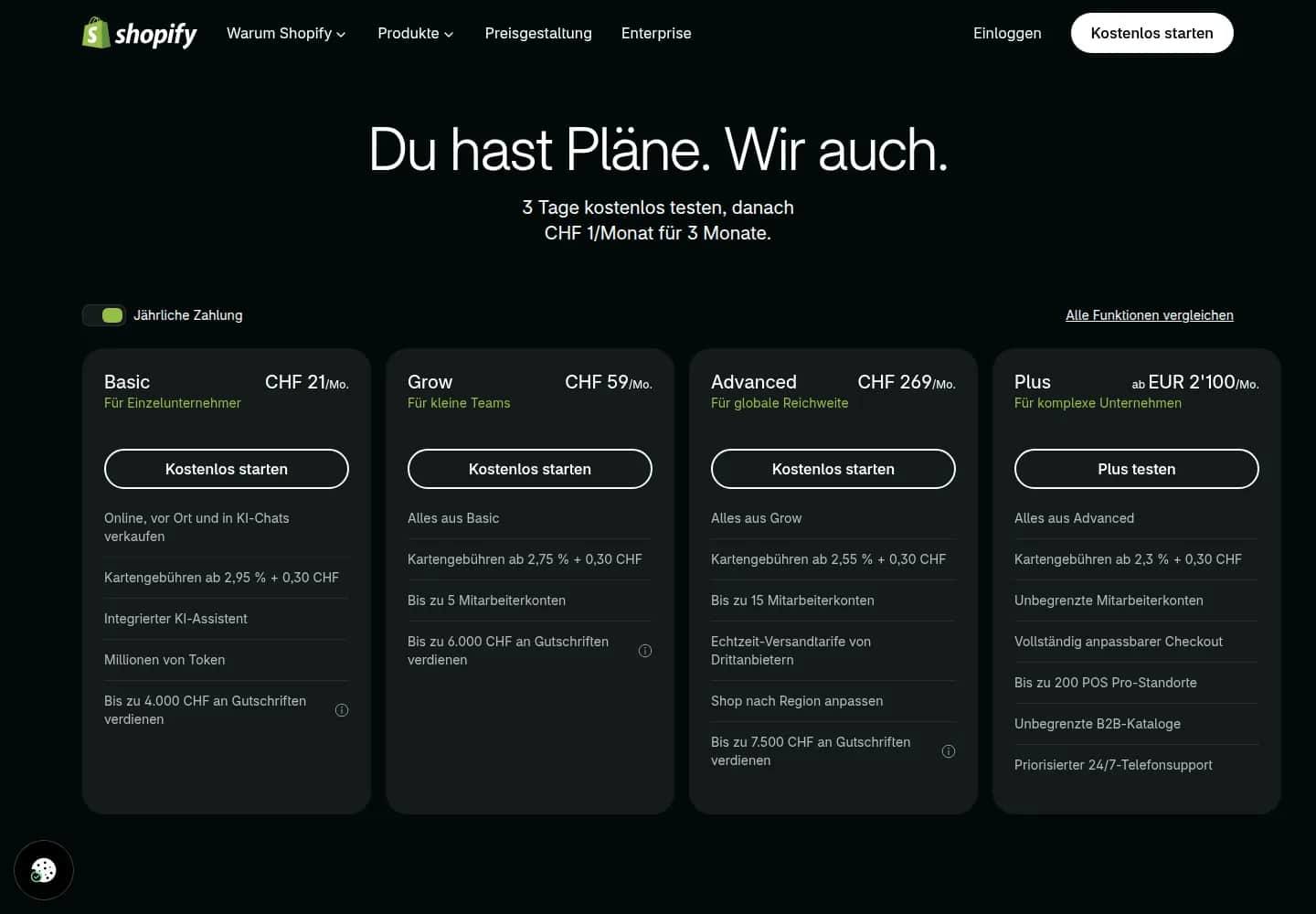
Shopify's Swiss price list, billed yearly
shopify.com/ch/preise, screenshot of 30.09.2026 (German-language page; no English Swiss page exists)
PrestaShop Hosted and Shopware publish their prices in euros, not Swiss francs, so the chart below shows Shopify's own CHF tiers rather than a cross-vendor comparison.
Shopify's own Swiss-franc price ladder, per the list read 30.09.2026
Shopify Switzerland pricing page, read 30.09.2026
What's in the subscription, and what you pay separately
The subscription generally covers hosting, software updates and an SSL certificate. You pay separately for payments (where TWINT is cheaper than a card on every Shopify plan), apps and themes, and a higher plan once you cross a limit.
It's also worth knowing what uptime commitment a vendor makes and what happens if the store goes down — that's the subject of a service-level agreement (SLA).
Open source: WooCommerce and PrestaShop — free code, everything else billed
WooCommerce and PrestaShop are open-source software: you download the code without a licence fee, and nobody takes a cut of your sales. You pay for everything around it.
WooCommerce describes itself as "the free, open-source ecommerce platform for WordPress." Its own pricing page gives estimates in US dollars: hosting $25–350 a month for most stores, extensions $29–299 a year each — no platform fees, no revenue share.
PrestaShop in its self-hosted, open-source form is free. Its hosted, subscription version is priced in euros.
Beyond hosting and extensions, open source carries two cost lines no vendor price list shows: implementation (configuration, template, integrations), and updates and upkeep — you do this yourself or pay a contractor for it every month.
Payments — standard rates, and where TWINT is cheaper
Whatever the platform, every payment costs something. Standard published rates, read 30.09.2026:
- [Stripe](https://stripe.com/ch/pricing): Swiss cards 2.9% + CHF 0.30; international cards 3.25% + CHF 0.30 plus 2% for currency conversion. Local methods: TWINT 1.9% + CHF 0.30, SEPA Direct Debit CHF 0.40.
- [Shopify Payments](https://www.shopify.com/ch/preise) (Basic): standard cards 2.95% + CHF 0.30; TWINT 1.75% + CHF 0.30.
- [PostFinance Checkout](https://www.postfinance.ch/en/business/products/payment-collection/online-shop.html), All-in-One (for turnover up to CHF 200,000/year): CHF 199 setup, then CHF 14.90/month, plus 2.5% (min. CHF 0.20) per transaction, covering Visa, Mastercard, PostFinance Pay, TWINT, Apple Pay and Click to Pay.
- PostFinance Checkout, E-Com Bundle (CHF 200,000+/year): free setup, CHF 19.90/month, plus PostFinance Pay/TWINT 1.3%, cards 1.55% (each min. CHF 0.20), plus a CHF 0.18 PSP fee per transaction.
TWINT costs less than a card at Stripe, at Shopify Payments and in PostFinance's E-Com Bundle (the All-in-One plan charges the same flat rate for every method), which makes it worth promoting at checkout rather than treating it as an optional extra. Fixed fees (CHF 0.30 at Stripe and Shopify Payments, the CHF 0.18 PSP fee at PostFinance) and per-transaction minimums (CHF 0.20 at PostFinance) matter most on cheap orders. More on choosing payment methods and delivery is in payments and logistics.
Implementation and setup — get quotes, not averages
We know of no publicly available Swiss benchmark of online-store build costs, so we don't quote one. Build costs depend on your scope and on who does the work. For an implementation-cost estimate, use the subscription and payment figures above as your baseline, and get two or three comparable quotes from agencies or freelancers for your own scope.
If you're considering a store in a headless architecture — a separate front end connected over an API — that's its own cost category, covered in headless vs. classic store.
Monthly store costs (TCO) — how to work them out
The monthly cost of running a store is the sum of small, recurring bills that grow with sales. The simplest approach is to lay them out once across seven categories, then update them every month.
Separate one-off costs from recurring ones first
One-off costs are the launch or a migration: a template or design, configuring tax and shipping, integrations, importing products, training your team. Recurring costs are everything that comes back every month. Mixing the two leaves you with money for the launch and no reserve for the fixed bills that follow.
1. Platform and technology
The SaaS subscription or hosting, paid apps and plugins, the domain, monitoring. Check the plan's limits — products, orders, admin accounts — since crossing them moves you to a higher tier. Once a quarter, review the list of add-ons: what each one costs, what it does, whether it duplicates another one, and whether it slows the store down.
2. Payments
What matters here is the effective payment fee — how much you actually hand to processors relative to sales:
> effective fee = (total processing fees + chargeback costs + payment-refund costs) ÷ online payment volume
In Switzerland, this line moves a lot depending on the payment mix: on Stripe or Shopify Payments, a store that pushes TWINT at checkout pays noticeably less than one that defaults to cards. Add the flat per-transaction fee and any PSP fee (PostFinance Checkout's E-Com Bundle adds CHF 0.18 per transaction on top of its headline rate) before comparing providers.
3. Delivery and returns
Shipping cost isn't one rate but a matrix: size, weight, zone, surcharges for odd-shaped parcels. On top of that, returns — with Swiss Post's business reply label the return is free for the customer and billed to you, and inspecting the goods and repackaging cost staff time on top. One metric rolls all of it up:
> logistics cost per order = (shipping + returns + fulfilment + packaging + operational labour) ÷ orders fulfilled
Compare it against your average order value and your free-delivery threshold.
4. Marketing and content
Ads, email and SMS tools, a product-feed tool, photos and copy, translations. Measure it against sales, not just as a number.
5. Technical upkeep and security
Updates, testing after each update, backups with a periodic restore test, uptime and error monitoring.
6. People and operations
Customer service, entering products, fixing data, handling returns, reporting. Count the hours even if you do it yourself.
7. The cost of leaving a platform
What matters here is what data you can take with you, and in what format, once you try to switch. Per Shopify's own help pages, you can export customers, orders and products to CSV. For any other platform, check its export documentation before you sign. A CSV is data, not a store — design, configuration, URLs and redirects all need rebuilding elsewhere. How to move without losing search rankings is covered in ecommerce migration and SEO; the store migration checklist helps too.
A worked example: platform and payment method on 100 orders at CHF 50
To show how different billing models and payment methods translate into an actual figure, we worked out one month for three combinations. This is a worked example, not an offer or a recommendation.
Assumptions: 100 orders a month at CHF 50 each, so CHF 5,000 in sales; every order paid online; the platform billed monthly, no promotional pricing; no one-off fees, apps, returns or chargebacks. Rates from the price lists read 30.09.2026.
Shopify Basic + Shopify Payments (TWINT). Subscription CHF 29. Fee: 1.75% × CHF 5,000 = CHF 87.50, plus CHF 0.30 × 100 = CHF 30. Total: 29 + 87.50 + 30 = CHF 146.50.
Shopify Basic + Shopify Payments (standard card). Same subscription, CHF 29. Fee: 2.95% × CHF 5,000 = CHF 147.50, plus CHF 0.30 × 100 = CHF 30. Total: 29 + 147.50 + 30 = CHF 206.50 — CHF 60 more than TWINT, on the same platform, for the same sales.
WooCommerce (self-hosted; hosting and extensions not included here) + PostFinance Checkout All-in-One. Setup fee excluded as a one-off. CHF 14.90/month, plus 2.5% × CHF 5,000 = CHF 125 (already above the CHF 0.20 per-transaction minimum). Total: 14.90 + 125 = CHF 139.90.
What you pay the platform and the payment method on 100 orders at CHF 50 — a worked example
Digital Vantage worked example based on Shopify Switzerland and PostFinance Checkout pricing pages, read 30.09.2026
What does this show? The biggest lever in this comparison isn't the platform — it's whether the customer pays by TWINT or by card: CHF 60 a month, on the same 100 orders, same platform. Change the basket size and the ranking can shift too: a higher basket makes the percentage matter more, a lower one makes the flat per-transaction fee matter more. Calculate it on your own numbers.
A rhythm for reviewing costs
TCO calculated once goes stale fast. A simple rhythm: every month, compare costs against plan across the seven categories; every quarter, review apps and plugins, courier and provider rates, and before signing a new contract, ask two or three vendors for comparable quotes under the same terms. Bring your own data to that conversation: a few months of sales, the mix of payment methods used (how much is TWINT versus card matters a lot here), and the number of disputes.
Your own ecommerce website cost — working it out
To turn these prices and formulas into your own numbers:
- Setup cost — work it out in the store setup cost calculator, which compares platforms, integrations and payments in a few minutes.
- Monthly cost over a few years — the ecommerce TCO calculator sums the subscription or hosting, add-ons, fees and upkeep. Check subscription and fee rates one last time against the price lists linked above — those are the ones that bind you.
- Choosing a platform — if you're torn between models, try the which e-commerce platform quiz, or read the platform comparison.
- Starting with no budget — what's genuinely free, and where the free tiers stop, is in our article on a free online store.
More on platforms is gathered in ecommerce platforms.
FAQ
Frequently asked questions about the cost of an online store
There are two bills: a one-off setup cost and a recurring monthly cost. On the SaaS side, Shopify Basic costs CHF 29/month billed monthly or CHF 21/month billed yearly on the Swiss price list (read 30.09.2026). Every month you also pay for payments — where TWINT is cheaper than a card at Stripe and Shopify Payments — plus delivery, marketing and upkeep. We know of no public Swiss benchmark of implementation costs, so for a build-cost estimate, request comparable quotes for your own scope.
Per the Swiss price list read 30.09.2026, Shopify Basic costs CHF 29/month billed monthly or CHF 21/month billed yearly. On top of that come payments: Shopify Payments charges 2.95% + CHF 0.30 per card payment on Basic, but only 1.75% + CHF 0.30 for TWINT. Using an external gateway instead of Shopify Payments adds a further 2% surcharge on that plan.
The software is — WooCommerce is a free, open-source WordPress plugin and takes no cut of your sales. What costs money is hosting (the vendor itself estimates $25–350/month for most stores), extensions ($29–299/year each), implementation, and ongoing updates and technical upkeep.
Break them into seven categories: platform and technology, payments, delivery and returns, marketing and content, technical upkeep, people and operations, and the cost of leaving the platform. For payments in Switzerland, the choice between TWINT and cards can matter as much as the choice of platform: in our worked example on 100 orders at CHF 50 each, the same Shopify plan costs CHF 146.50 with TWINT versus CHF 206.50 with a standard card.
At Shopify Payments and Stripe, yes. On Shopify Payments (Basic plan), TWINT costs 1.75% + CHF 0.30 against 2.95% + CHF 0.30 for a standard card; Stripe charges 1.9% + CHF 0.30 for TWINT against 2.9% + CHF 0.30 for a Swiss card. On 100 orders at CHF 50 each, that difference is CHF 60 a month on Shopify Payments Basic and CHF 50 on Stripe. PostFinance Checkout All-in-One charges the same flat 2.5% for every method; its E-Com Bundle charges 1.3% for TWINT against 1.55% for cards.
Want to work out the cost of your own store?
We'll help you compare platforms on your own numbers — subscription, fees, setup and monthly costs — before you sign anything.
Related Posts
- E-commerce platform — models, how to choose one and a guide to online store platforms
E-commerce platform for Switzerland: SaaS, open source or headless, five selection criteria, TWINT and payment fees, data export and a guide to the section.
- 1.B2B ecommerce platform — what it is, how it differs from B2C and how to roll it out
A B2B ecommerce platform means per-customer pricing, credit limits, ERP integration, SaaS vs open source, Swiss invoicing (QR-bill) and a rollout plan.
- 2.Website migration SEO for online stores — a step-by-step plan, 301 redirects and data export
Website migration SEO for online stores: a 301 redirect map, data export, INP after launch and 90 days of monitoring, per Google's guidance.
- 3.Headless commerce — when a headless store makes sense, and when a classic one is enough
Headless commerce without the hype: how it differs from a classic store, Shopify Hydrogen, Medusa JS and Shopware pricing, costs, SEO, and when to skip it.
- 4.E-commerce Platform Comparison — Shopify, WooCommerce, PrestaShop, Shopware and More, by Price List and Exit Terms
Ecommerce platform comparison for Switzerland: Shopify, WooCommerce, PrestaShop — model, CHF price, fees incl. TWINT and data export, as of September 2026.
- 5.How to Start an Online Store Step by Step — Product, Registration, Platform and Legal Duties
How to start an online store in Switzerland: validating demand, VAT registration, choosing a platform, legal duties and payments for your first 90 days.
- 6.Free Online Store — What's Actually Free, and What Always Costs Money
Free online store in Switzerland: what's genuinely free in Shopify, Wix and WooCommerce per 30.09.2026 price lists, and when a free plan stops paying off.
- 1.
About the Team
Digital Vantage Team
Your Partner in Business, Digital Vantage Team
Digital Vantage team is a group of experienced professionals combining expertise in web development, software engineering, DevOps, UX/UI design and digital marketing. Together we carry out projects from concept to implementation - websites, e-commerce stores, dedicated applications and digital strategies. Our team combines years of experience from technology corporations with the flexibility and immediacy of working in a smaller, close-knit structure. We work in agile methodologies, focus on transparent communication and treat each project as if it were our own business. The strength of the team is the diversity of perspectives - from systems architecture and infrastructure, frontend and design, to SEO and content marketing strategy. As a result, the client receives a cohesive solution where technology, aesthetics and business goals go hand in hand.