Cookies

We use cookies for analytics and advertising. You can accept all, keep only necessary, or customize your preferences. Cookie Policy

Digital Vantage LogoDigital Vantage Logo
  • About us
  • Offer
    • Websites
    • Ecommerce development
    • Web Applications
    • Applications
    • AI implementation
    • Technology consulting for companies
    • Online marketing and branding
  • Resources
    • Blog & News
    • Tools and calculators
    • Templates and checklists
    • Independent industry reports
    • Partner programme
  • Contact
Let's talk!
English|Français
Digital Vantage LogoDigital Vantage Logo
  • About us
  • Offer
  • Resources
  • Contact
  • Search articles⌘K
  • EN|FR
    • Websites
      Building a professional online presence
    • Ecommerce development
      Stores on PrestaShop, Shopify or custom code
    • Web Applications
      Dedicated web applications - automate and grow your business!
    • Applications
      Custom solutions tailored to your business needs
    • AI implementation
      AI chat, automation and AI agents, priced before we start
    • Technology consulting for companies
      That support business Technology consulting for companies where technology has stopped keeping up with business
    • Online marketing and branding
      Designing logos, corporate colors and letterheads
    • Blog & News
      News from the digital world.
    • Tools and calculators
      Before you start talking to an agency, check how much your project should cost.
    • Templates and checklists
      Professional checklists for B2B companies
    • Independent industry reports
      Cyclical report programs based on publicly available sources
    • Partner programme
      Agency discounts and referral commissions
Let's talk!
  1. Home›
  2. Our offer›
  3. AI implementation for business›
  4. AI agent development for business
AI IMPLEMENTATION · AI AGENTS

AI agent development for business: the agent prepares the case, and you approve it with one click

We build AI agents that read emails, check your CRM and ERP, and prepare each case for a decision. Your team approves instead of retyping. We start with one process and a test on 20–50 of your real tasks.

  • Fixed price after the audit, before we write the first line of code.
  • A person always approves irreversible actions: an email to a customer, a refund, a payment.
  • Code and model instructions in your repository after every project stage.
from CHF 10,000
AI agent, excl. VAT
5–8 weeks
to build a supporting agent
20–50
of your tasks tested before launch
CHF 0.17
model cost per 10-step task
  • Book a call about your agent
  • Pick a time for the call

Call: 15 minutes, video or phone · Prefer to call? +48 663 877 600
Digital Vantage LogoDigital Vantage Logo

Digital Vantage
Tel+48 663 877 600, +48 22 152 51 05
Andriollego 34, 05-400 Warsaw
REGON: 540674000
EU VAT: PL5321813962

Services
  • Websites
  • Company websites
  • Landing page
  • Web applications
  • Mobile apps
  • MVP for startups
  • Software development
  • Technology consulting
  • Online marketing and branding
  • Website pricing
Digital Vantage
  • About us
  • Contact
  • Let's talk about your business
  • Partner programme
  • Resources for business
  • Site map
Articles and guides
  • Websites
  • Online stores
  • Starting a business online
  • Web applications
  • Business applications
  • Google Business Profile
  • SaaS software
  • Glossary
Industry reports
  • Polish web market price analysis
  • Website costs
  • Online store costs
  • Web application costs
  • Mobile app costs
  • SaaS tool costs
Tools and calculators
  • Website cost
  • Online store cost
  • Web application cost
  • Website maintenance cost
  • Online store TCO
  • Website speed test
  • Quiz: website or app
  • Quiz: which e-commerce platform
  • Quiz: WordPress or headless
  • Quiz: ready-made SaaS or custom
Checklists and templates
  • Launching a website
  • Website audit
  • E-commerce UX checklist
  • Store migration
  • Choosing a web agency
  • Website security
Follow Us
FacebookInstagram
© Digital Vantage - Warsaw, Poland
Cookie PolicyPrivacy PolicyConditions
English|Français
© 2026 Digital Vantage. All rights reserved.
Digital Vantage LogoDigital Vantage Logo

Digital Vantage
Tel+48 663 877 600, +48 22 152 51 05
Andriollego 34, 05-400 Warsaw
REGON: 540674000
EU VAT: PL5321813962

★ 5.0
Google reviews
24h
We reply on business days.
20+ yrs
in IT/B2B EMEA
100/100
Desktop PageSpeed
© Digital Vantage - Warsaw, Poland
Cookie PolicyPrivacy PolicyConditions
English|Français
© 2026 Digital Vantage. All rights reserved.
WHERE AN AGENT PAYS OFF FASTEST · 4 PROCESSES

Processes where an AI agent pays off fastest

An agent makes sense where an employee reads text, checks two or three systems and only then decides. These are the four processes we see most often.

01|Quote requests

400 requests a month, 15 minutes each

A salesperson looks up the client in the CRM, checks the price list and writes a reply. The agent does the same in the background and leaves a ready draft. The employee reads it, fixes one sentence and sends it.

02|Complaints and returns

Every case is different, the terms run to 40 clauses

The agent gathers the order data, the customer's history and the photos from the email, matches the right clause of the terms and proposes a decision with its reasoning. A person decides on the refund.

03|Orders from email into the ERP

2–3 hours a day of retyping

Orders arrive by email, as PDFs and in the message body, in a different layout every time. The agent reads the line items, checks the product codes in the ERP and fills in the order. An employee approves it with one click.

04|Qualification and meetings

A Friday 7 p.m. enquiry waits until Monday

The agent asks about scope, budget and timing, records the contact in the CRM and offers a free slot from the calendar. That is how Vi works — our own assistant on digitalvantage.pl, in Polish.

⇲

A simple test: if the list of “if… then…” rules for a process is complete, automation will do, not an agent. It is cheaper and predictable — we describe it in our process automation offer.

↳ Can the process be written down as rules? See process automation — CHF 7,500–15,000 excl. VAT per process, 2–4 weeks.

OPTIONS · 3 WAYS TO START · PRICES EXCL. VAT

Three ways to your first agent — with prices

Each option has a “from” price excl. VAT and a timeline. After the audit or specification you get a fixed price before we start building.

ENTRY · AI AUDIT

Not sure whether the process suits an agent

CHF 1,950
excl. VAT
5 days
working days

Included: a 2-hour workshop with your team, a review of 3 processes, a recommendation for each (agent, automation, chat or nothing) and an agent specification with a fixed price.

Order the build within 60 days and we credit 100% of the CHF 1,950 towards it.

⇲
OPTION 1 · SUPPORTING AGENT

The agent reads and prepares, a person sends

from CHF 10,000
excl. VAT
5–8 weeks
typical timeline

Who it's for: one process, 1–2 systems.

Included: read tools, drafts (reply, note, proposed decision), an approval panel, a test on 20–50 tasks, limits and action logs. An employee approves every send.

OPTION 2 · AGENT WITH INTEGRATIONS

Agent with integrations — CRM, ERP, email, calendar

from CHF 17,500
excl. VAT
8–12 weeks
typical timeline

Who it's for: a process that runs across 2–4 systems, where the agent also has to write to them, not just read.

Included: everything in option 1, write tools with permissions enforced by the system, approval of irreversible actions, hand-over to a person with the full history, tests of refusals and of attempts to hijack the agent.

What raises the price: each additional system costs about CHF 2,500–4,000; a system without an API needs extra integration work; more actions to approve mean more screens in the panel; action logs kept for audits in a regulated industry.

METHOD · HOW WE CHOOSE THE SOLUTION

Agent, automation or chat — how we choose

Of the three, an agent has the highest cost per task and is the least predictable. So we start by asking whether you need one at all. One column decides it: what happens in the process.

What happens in the process

Solution

Start-up cost (excl. VAT)

Cost per task

Who approves

The rule is complete: “if the invoice is from X, book it to Y”

Automation

CHF 7,500–15,000

fractions of a cent, often zero

nobody, the rule runs on its own

The answers are in documents, nothing changes in your systems

Chat or AI assistant

from CHF 4,250

approx. CHF 0.08 per conversation

nobody, the chat only answers

Someone has to read text, check 2+ systems and propose a decision

AI agent

from CHF 10,000

approx. CHF 0.17 per 10 steps

an employee, for every irreversible action

In none of the options do we leave decisions about people, such as in recruitment, or payments to an agent without a human involved. How an agent differs technically from a chat and from automation, we explain in the article AI agent in business. All our AI services with prices are listed on the AI implementation page.

PERMISSIONS · 4 RULES

An agent can do what the system allows — not what the prompt says

The instruction “don't send emails” is not a safeguard. A tool that cannot send email is. We build every agent on these four rules.

01

A separate agent account with minimal permissions

The agent logs in to the CRM and ERP with its own account. If the account is read-only, nothing gets written, whatever the model decides.

02

Read-only at first

The first version searches, reads and drafts. We add write tools only once the action logs show that the agent handles reading well.

03

API keys out of the agent's reach

Keys to your systems are added by a proxy that runs outside the agent. The agent calls the API but never sees the key, so it cannot leak it.

04

Email content is data, not instructions

An email or document can try to take control of the agent — this is prompt injection, the first risk on the OWASP list for large language models. Narrow permissions, approvals and fixed formats between steps limit it. More on how agents work in the article AI agent in business.

OUR OWN DEPLOYMENT · LIVE SINCE OCTOBER 2026

Vi: how we put limits on our own AI that writes to the CRM and books meetings

Vi is the AI chat on digitalvantage.pl, our Polish-language site. It doesn't plan multi-step tasks like a full agent, but it uses tools that change data in our systems. We used it to test the rules we apply for clients.

WRITE TOOLS

Writes to the CRM

It creates a contact and a sales opportunity, adds a note with a link to the conversation and a task for the team — through 5 operations of our CRM's API. The key it connects with opens only those operations and reaches nothing else in the system. The integration is covered by 25 contract tests and 33 API tests.

BOOKING WITHOUT GUESSING

Books a slot from the calendar

It shows only slots returned by the calendar and books exactly the one picked from the list. If the slot disappears in the meantime, it fetches the list again and doesn't claim success. It doesn't book without an email address. It takes the time zone from the browser.

HAND-OVER TO A PERSON

Hands the case over with its history

It hands over in 6 situations, including when the visitor asks for it, when it has no answer, for complaints and for a hot sales lead. After hand-over the bot stays silent. Outside working hours it offers a call slot instead of promising a quick reply.

BRAKE

Has limits set in the system

A monthly token budget — once it is exceeded, the bot stops using the model and hands the case to a person; outside working hours it sends one pre-written message. The booking system accepts at most 10 bookings per hour from one address, and all of Vi's bookings come from one server — that is the ceiling for the whole chat. A cheaper model extracts the data for the CRM, because it is good enough for a fixed format.

We will add Vi's first results — the share of conversations handed to a person and of meetings booked — after 4 weeks of observation, in November 2026.

↳ See it for yourself: pick a time for a call in the form below — the slots offered come from our calendar.

WHAT YOU GET · 4 THINGS INCLUDED

What you get with every agent — included in the price

These four things come with every option, not as extras. Code, instructions and tool definitions go into your repository after every project stage.

01|Specification

“Task done” defined as a state in the system

“The agent wrote ‘booked’” is not a criterion. “The booking exists in the calendar” is. The specification also lists the tools with their risk level and the actions that need approval.

02|Tests

20–50 test tasks from your own cases

The set is built from real cases, including those where the agent should refuse. We run each task several times, because one successful attempt proves nothing. You get the results in writing.

03|Limits

Steps, budget and rate written into the specification

A step limit per task, a monthly budget and a request limit per user. Once a limit is exceeded, a person takes over. What happens after the limit doesn't depend on the model.

04|Logs and support

Action logs and 30 days of support after launch

Every tool call, its parameters and its result go into the logs. For 30 days after launch we read them with you and refine the instructions and tools.

PROCESS · 5 STAGES · 5–12 WEEKS·5 steps

How an AI agent is built — 5 stages, 5–12 weeks

Each stage ends with something you sign off. The time in brackets applies to an agent with integrations.

  1. 5 working days
    Audit and specification

    What you get: a document with the task, the “task done” criterion, the tools with their risk level, the actions to approve, the limits and a fixed price.

  2. 1–2 weeks (2–3 weeks)
    Prototype on the best model, read-only

    What you get: a working prototype plus the accuracy, time and cost of a single task. We swap in a cheaper model where the test shows it is enough — as with data extraction in Vi.

  3. 1–2 weeks (2–3 weeks)
    Tests on 20–50 tasks

    What you get: results from several runs of each task, refusal tests and a list of what the agent does well and what it can't do yet.

  4. 2–3 weeks (3–5 weeks)
    Launch on part of the cases

    What you get: the agent working on part of the cases, a weekly log review and fixes to the instructions and tools.

  5. Ongoing · CHF 450–750/month
    Extending permissions and maintenance

    What you get: a new tool only once the logs show the agent handles the current ones, and tests before every model change.

In total: supporting agent 5–8 weeks, agent with integrations 8–12 weeks. Payment 30/40/30: 30% when the prototype starts, 40% at testing, 30% at launch on part of the cases. The CHF 1,950 audit is credited towards the build.

PRICE AND MONTHLY COST · EXCL. VAT

AI agent — build price and monthly cost

You pay for the build once. Three items come every month — model tokens, hosting and maintenance. You see each one separately before you sign the contract.

from CHF 10,000
AGENT BUILD · ONE-OFF
CHF 0.17
TOKENS · 10-STEP TASK
from CHF 75
HOSTING · MONTHLY
CHF 450–750
MAINTENANCE · MONTHLY
PAYBACK · AN EXAMPLE, NOT A PROMISE

When an agent pays for itself — the numbers

Process: replies to quote requests. Staff cost CHF 64/h — the average hourly labour cost in Switzerland from the Federal Statistical Office's labour cost survey (CHF 63.62 for 2020, the latest published survey). It varies by industry and region, so put in your own rate.

01

Today

400 requests a month × 15 minutes per reply.

100 h/month
02

With the agent

The agent prepares the reply from the price list and the CRM; an employee checks it and approves it in 3 minutes.

20 h/month
03

Time saved

80 hours × CHF 64/h.

CHF 5,120/month
04

Cost of running the agent

Tokens 400 × CHF 0.17 ≈ CHF 70, hosting CHF 75, maintenance CHF 450 (lower bound).

approx. CHF 595/month
05

Net gain each month

A supporting agent at CHF 10,000 pays for itself in just over 2 months, an agent with integrations at CHF 17,500 in about 4.

approx. CHF 4,525/month

Tokens: Claude Sonnet 5.5, USD 2 per 1M input tokens and USD 10 per 1M output tokens (Anthropic pricing, read on 13 October 2026), converted at the ECB reference rates of 13 October 2026 (USD 1 ≈ CHF 0.8323). Task: 10 steps, on average 8,000 input and 500 output tokens per step = USD 0.21 (≈ CHF 0.17), without the prompt-cache discount. 1,000 tasks ≈ CHF 175. Each extra loop costs about CHF 0.02, so the step limit sets the upper bound on the cost of a task.

↳ The token calculation step by step: how much an AI agent costs. The wider picture — where to start with AI and what it costs: AI in business. Model pricing: Anthropic, Pricing.

Got a process for your first agent?

In 15 minutes we'll check whether it needs an agent, automation or a chat. You leave with an answer, not a sales pitch.

Book a callChoose a time slot

↳ The call takes 15 minutes, by video or phone. Prefer to call? +48 663 877 600

RISKS · 3 CONCERNS AND WHAT WE DO ABOUT THEM

Three risks of an AI agent and how we remove them

01|Risk

The agent does something irreversible

A separate account with minimal permissions, read-only at first. An email to a customer, an order cancellation, a refund and a payment always wait for an employee's approval.

02|Risk

It gets stuck in a loop and runs up the bill

A step limit per task, a monthly budget and a request limit per user. Once a limit is exceeded, a person takes over. When the agent doesn't know something, it hands the case over instead of guessing — more in the article AI agent in business.

03|Risk

The platform disappears or changes its settings

The code and instructions are yours. We build in n8n or Node.js, not in a model vendor's closed builder. Before every model or tool change we run regression tests.

NOT A FIT

When an AI agent doesn't pay off

In these three situations we recommend a simpler or different solution.

The rule is complete

If every case can be described as “if… then…”, automation at CHF 7,500–15,000 will be cheaper and predictable.

⇲

It's only about answers from documents

If nothing needs to change in your systems, a chat or an assistant with a knowledge base is enough, from CHF 4,250. We describe this option on the page AI implementation.

⇲

Systems without an API, data in spreadsheets

The agent has nothing to reach for. First comes order in your data and systems — that is where technology consulting starts.

⇲
TECHNOLOGY · WHAT EACH IS FOR

What we build agents with

  • n8n — when your team needs to see the process. The AI Agent node can require approval before a chosen tool. We also use it in process automation.
  • Node.js — when you need full control over the tools and tests.
  • Claude and OpenAI via API — you pay for usage and switch providers in the configuration. Tests show whether the agent works the same on a new model.
  • MCP (Model Context Protocol) — a standard for connecting a model to tools. We set permissions the same way: in the system, not in the prompt.
FAQ · 8 QUESTIONS

Questions before building an AI agent

A supporting agent costs from CHF 10,000, an agent with integrations from CHF 17,500, excl. VAT. The entry point is a CHF 1,950 AI audit, credited towards the build if you order it within 60 days.

Monthly: tokens approx. CHF 0.17 per 10-step task (1,000 tasks ≈ CHF 175), hosting from CHF 75, maintenance CHF 450–750.

A supporting agent takes 5–8 weeks, an agent with integrations 8–12 weeks, counting from the 5-day audit. It depends most on the number of systems and on how quickly we get access to their APIs and 20–50 sample cases for testing.

You end the project after stage 03. You pay 30% and 40% of the price, i.e. for the prototype and the tests. The code, instructions, test set and results stay with you. The results also show which part of the process can be automated with rules alone.

You do. The code, model instructions, tool definitions and test set go into your repository after every project stage. You can develop the agent further with another contractor or your own team.

It processes only the data the task needs, from the systems listed in the specification. We host the application and logs on servers in the EU (Warsaw) or on your infrastructure. Poland is on the Federal Council's list of countries with adequate data protection, so the transfer needs no additional safeguards. The model region is written into the specification, and you sign a data processing agreement with us (Art. 9 nFADP). We agree the log retention period before launch.

If it contacts people in the EU, yes: Art. 50 of the EU AI Act applies from 2 August 2026, also to Swiss companies whose AI system or its output reaches the EU, and the European Commission's non-binding guidelines of 20 July 2026 explicitly cover agents that handle correspondence or book appointments. In Switzerland, the FDPIC's position is that under the nFADP users have a right to know whether they are corresponding with a machine. So the agent discloses that it is AI and on whose behalf it acts; emails from our agents carry an AI label at the top. Details in the article EU AI Act for a Swiss business.

A subscription agent works on whatever you paste in or share with it, with the vendor's settings. Ours works in your 2–4 systems, on a separate account, with limits and a log of every step. When a subscription is enough, we explain in the article ChatGPT Business, Copilot or Gemini.

The first 30 days of support are included. After that, maintenance costs CHF 450–750 a month and covers log reviews and tests before every model change. The notice period goes into the contract before launch. When maintenance ends, the agent keeps working and the code stays with you.

RESOURCES · BEFORE WE TALK

Before we talk

ARTICLE

AI agent in business — when it makes sense

How an agent differs from a chat and from automation, and what it costs in tokens.

⇲
ARTICLE

AI in business — where to start

Where to start with AI, what it costs and what the law says.

⇲
ARTICLE

EU AI Act for a Swiss business

When the EU AI Act applies to a Swiss company, and what the nFADP already requires.

⇲
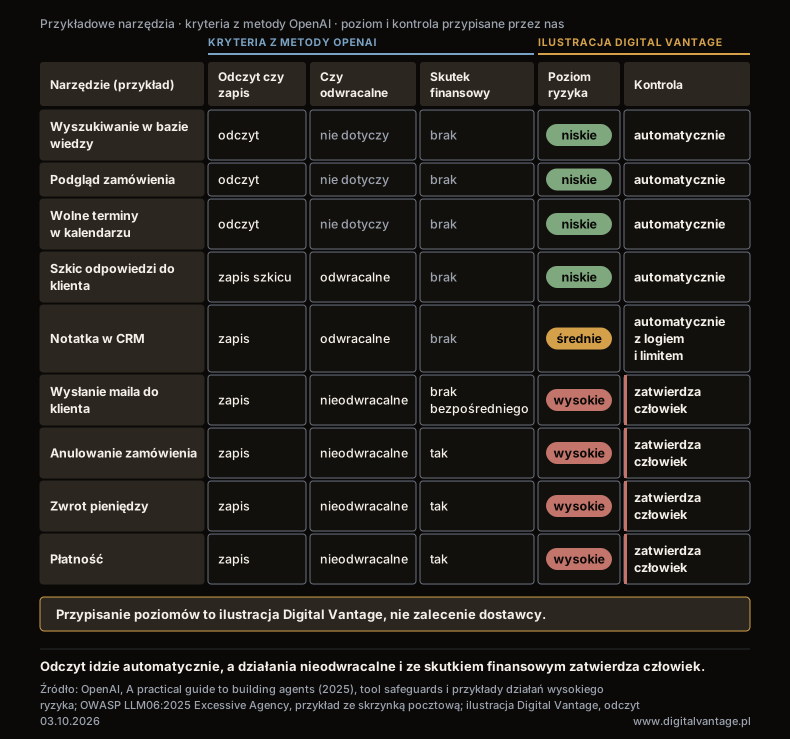
Every agent tool has a risk level — and a control

Every agent tool has a risk level — and a control

9 example tools · 4 automatic, 1 with a log and a limit, 4 approved by a person

Digital Vantage analysis. The criteria for assessing a tool (read or write, reversibility, financial impact) and the low–medium–high scale follow OpenAI's guide “A practical guide to building agents”; the rating of each tool and its control are our own.

Chart description

Matrix of nine example tools in rows, with columns: read or write, reversible, financial impact, risk level, control. Knowledge base search: read, not applicable, none, low risk, automatic. Order lookup: read, not applicable, none, low, automatic. Free calendar slots: read, not applicable, none, low, automatic. Draft reply to a customer: draft write, reversible, none, low, automatic. CRM note: write, reversible, none, medium, automatic with a log and a limit. Sending an email to a customer: write, irreversible, no direct impact, high, approved by a person. Cancelling an order: write, irreversible, yes, high, approved by a person. Refund: write, irreversible, yes, high, approved by a person. Payment: write, irreversible, yes, high, approved by a person.