SEOCosts and pricingVendors and contracts18 min reading time23,058 characters3,555 words
SEO cost — a calculation instead of a price range
No independent Swiss benchmark for SEO cost exists. How to turn a fee and its hours into an hourly rate, in francs, and what to ask before signing.

Redakcja Digital VantageYour Partner in Business, Digital Vantage Team · Digital Vantage team is a group of experienced professionals combining expertise in web development, software engineering, DevOps, UX/UI design and digital marketing. Together we carry out projects from concept to implementation - websites, e-commerce stores, dedicated applications and digital strategies.
Our team combines years of experience from technology corporations with the flexibility and immediacy of working in a smaller, close-knit structure. We work in agile methodologies, focus on transparent communication and treat each project as if it were our own business.
The strength of the team is the diversity of perspectives - from systems architecture and infrastructure, frontend and design, to SEO and content marketing strategy. As a result, the client receives a cohesive solution where technology, aesthetics and business goals go hand in hand.
Published
Updated
How much does SEO cost? Nobody has measured it independently in Switzerland. What you can find are agencies' price lists, agency blog posts quoting ranges, and two global surveys of SEO providers, and under every one of them sits the same sum: hours of work times a rate, plus links, content and tools. A price range won't tell you what you are buying. The sum will.
Backlinko, one of the two surveys, says its entry tier — "$500 or less" a month — usually buys "5-10 hours monthly". That is enough to turn a fee into an hourly rate, and the same division works on any SEO package, in dollars or in francs, whatever it is called. It also shows what a cheap retainer buys, what you will spend before SEO pays for itself, and which questions make two quotes comparable.
There is no single SEO cost — only price lists and two global surveys
We found no independent survey of SEO prices in Switzerland. Several Swiss agencies publish "what SEO costs" articles with ranges in francs, but they are written by firms that sell SEO and none says how its ranges were collected or from how many offers. Every figure in circulation comes either from a seller or from a poll of sellers: what providers say they charge, not what buyers pay.
The two polls are global. Ahrefs polled 439 SEO service providers (Ahrefs, SEO Pricing, updated 15 August 2024, no survey date given, read 4 October 2026). Respondents could name more than one billing model: 78.2% charge a monthly retainer, 48.9% per project and 34.8% by the hour. The most common retainer band is $501–1,000 a month, chosen by 20.4%. Treat Ahrefs' "averages" with care: they assume every provider charges the top of its band, which is how the page arrives at $3,209 a month for agencies.
Backlinko surveyed "over 300 SEO professionals" (Backlinko, SEO Pricing, updated 29 December 2025, read 4 October 2026), without publishing an exact count, a survey date or the questionnaire; the site is owned by Semrush, which sells SEO software. It puts the average retainer at $1,000–2,500 a month. Neither survey gives a figure for Switzerland, and we don't convert their dollars into francs: an exchange rate does not turn a global average into a Swiss price.
What a price tier buys: turning a fee into an hourly rate
Backlinko is the only one of the two surveys that puts both halves of the sum on one page. For each price tier it describes — it does not say it measured — how much work is typically included:
- "$500 or less": "usually 5-10 hours monthly"
- $501–1,000: "10-20 hours of dedicated SEO work monthly"
- $1,001–2,500: "20-40 hours of monthly work"
- $2,501–5,000: "40-80 hours of specialized work monthly"
- $5,000+: "80+ hours of expert work monthly"
Divide the top of each tier by its hours and the rate barely moves: $50–100 an hour in the two lowest tiers, $62.50–125 in the two middle ones. The top tier is open at both ends, so no rate follows from it; at its threshold, $5,000 over 80 hours is $62.50. That is our arithmetic on the author's description, not a survey result, but it agrees with Backlinko's own headline finding that hourly SEO services "average $50-$100 per hour". A bigger fee buys more hours, not a more expensive hour.
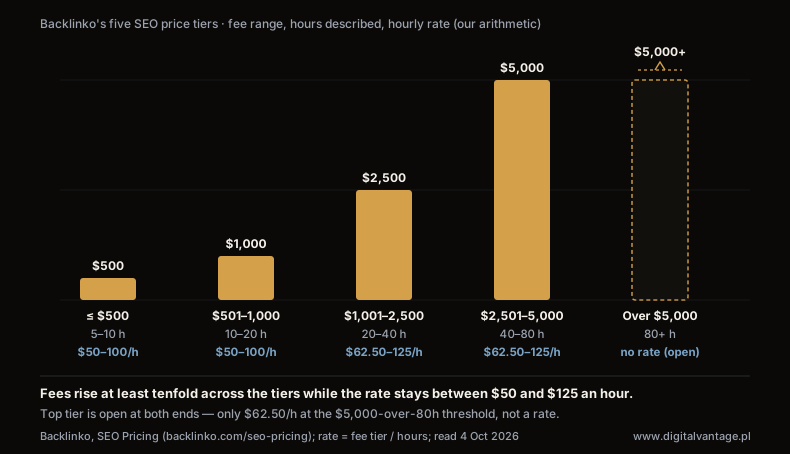
Backlinko's five SEO price tiers: more hours, not a pricier hour
Backlinko, SEO Pricing (backlinko.com/seo-pricing, updated 29 December 2025, read 4 October 2026); hours are the author's description of each tier, not a measured survey result; hourly rates are our arithmetic: top of each fee tier divided by its hour range, top tier at its 5,000-dollar threshold
Chart description
Bar chart of Backlinko's five monthly SEO price tiers in US dollars, with the hours Backlinko describes for each tier and the hourly rate at the top of each tier. Up to 500 dollars a month: 5 to 10 hours, 100 to 50 dollars an hour. 501 to 1,000 dollars a month: 10 to 20 hours, 100 to 50 dollars an hour. 1,001 to 2,500 dollars a month: 20 to 40 hours, 125 to 62.50 dollars an hour. 2,501 to 5,000 dollars a month: 40 to 80 hours, 125 to 62.50 dollars an hour. Over 5,000 dollars a month: 80 hours or more; no rate can be computed because both ends are open, and 5,000 dollars over 80 hours gives 62.50 dollars an hour at the threshold. Fees rise at least tenfold across the tiers while the rate stays between 50 and 125 dollars an hour.
The same division on Swiss price lists
Most Swiss price lists we read describe deliverables — pages optimised, articles a month, backlinks a month — and say nothing about hours. Two say how much work the fee buys, which is why we name them here, not as a recommendation. Two price lists are not a market; they show that the division works in francs and what to ask for.
AgenceSEO.ch (CEM Consulting Sàrl, Geneva; page updated 11 August 2026, read 5 October 2026) lists three monthly plans, Starter CHF 890, Growth CHF 1,890 and Premium CHF 3,490, and states that "tous les prix sont indiqués hors TVA" — all prices exclude VAT. Of the top plan, it says that a CHF 3,490 package "correspond le plus souvent à une quarantaine d'heures d'expert par mois, outils compris": usually about forty expert hours a month, tools included. That is roughly CHF 87 an hour, with the software inside the fee. The two lower plans list deliverables (pages, articles and, in Growth, links), not hours, so no rate follows from them.
Geekworkers (Geekworkers Sàrl, Lausanne; page updated 31 August 2026, read 5 October 2026) starts its SEO plan at CHF 900 a month excluding VAT for standard business sites, and for online shops and premium sites at CHF 1,200 a month excluding VAT, which it describes as "1.00 jour d'ingénierie" — one engineering day a month. That is CHF 1,200 a day.
Both rates are our arithmetic on what the vendors write, not measured hours. Any quote that states both a fee and an hour count lets you do the same division. If it states only the fee, ask for the hours. Credo, which matches companies with marketing agencies, calls the result a "blended hourly rate" and adds a warning: "Make sure you're not paying for W hours of one person's time at X hourly rate and Y number of hours at Z hourly rate" (Credo, SEO Pricing, page updated 25 July 2022, figures from its 2019 survey, read 4 October 2026). In other words: ask whose hours they are. A fee without hours can't be turned into a rate, so it can't be compared with anything.
Retainer, hourly, project or pay-for-performance: who carries the risk
Each billing model shifts the risk differently. A retainer is paid whatever happens, so your protection is transparency: a monthly list of hours, tasks, links and content. An hourly rate gives you the most control over how the time is spent. A project fee suits bounded work such as an audit or a migration: a defined deliverable at a defined price. The general logic of these models for a website build is covered in reading a website quote; here we deal only with what is specific to SEO.
Pay-for-performance seems to move the risk to the vendor: you pay only when a keyword reaches, say, the top ten. The catch is that a ranking is not one fixed number. Google's ranking systems look at "many factors and signals, including the words of your query, relevance and usability of pages, expertise of sources, and your location and settings", and Google uses "your location, past Search history, and Search settings to determine what is most relevant for you in the moment" (How Search Works, read 4 October 2026). In a country with four national languages, the same query typed in Zurich and in Lausanne can be a different search. Even Search Console reports position as an average: "the topmost position occupied by a link to your property or page in search results, averaged across all queries in which your property appeared" (Search Console Help). A contract that pays for a position has to say where, in which language, on which device, with which tool and how often it is checked. Otherwise you are paying for a number nobody has defined.
What drives the price up: size, competition, links, content, tools
Backlinko asked its respondents to rate what moves the price on a five-point scale: website size and complexity 5, industry competitiveness 4.5, the provider's track record and experience 4.2, service scope 3.8, geographic location 3.3. In Switzerland, add one more: every language version is, for search, a site of its own to optimise, and on the Geneva price list above, only the top plan adds international SEO in German, French and Italian. Among the items you can actually question in a quote, three matter most: links, content and tools.
Links: a paid placement is not automatically a safe link
A line called "link building" or "content placement" usually buys an article with a link in it. What that link means to Google depends on how it is tagged. Google's spam policies count as link spam "advertorials or native advertising where payment is received for articles that include links that pass ranking credit", but also say: "Google does understand that buying and selling links is a normal part of the economy of the web for advertising and sponsorship purposes. It's not a violation of our policies to have such links as long as they are qualified with a rel="nofollow" or rel="sponsored" attribute value to the <a> tag" (Spam policies for Google web search, read 4 October 2026). So ask how the links you are paying for are tagged.
Then ask what happens to them when the contract ends. The contract should say whether you own the texts outright or only hold a licence, and whether the links are bought or rented for as long as you pay. Links on sites the agency itself controls can vanish with the contract. The same policy lists "creating low-value content primarily for the purposes of manipulating linking and ranking signals" as link spam — reason enough to ask what those sites exist for besides carrying links.
Content: AI changes the effort, so it should change the price
Since 2023 Google has said it judges content by its quality, not by how it was made: "Our focus on the quality of content, rather than how content is produced", and "Appropriate use of AI or automation is not against our guidelines" (Google Search Central Blog, 8 February 2023, read 4 October 2026). The line it draws is scaled content abuse, a policy added in March 2024: "when many pages are generated for the primary purpose of manipulating search rankings and not helping users", "no matter how it's created" (spam policies).
Our inference, not Google's rule: if a text is mostly machine-written and a person only checks it, each piece should cost less, or the same budget should buy more of them. The same goes for a second or third language version produced by machine translation. Ask who writes what you pay for and how much expert review it gets; the answer tells you whether you are buying expertise or word count. SEO copywriting covers what writing for search involves.
Tools: what doing it yourself costs in licences
Much SEO work needs paid software, and the prices are public. At the publishers on 4 October 2026: Ahrefs Lite $129 and Standard $249 a month on monthly billing, or $1,290 and $2,490 a year paid annually, and Enterprise $1,499 a month with an annual commitment (Ahrefs pricing); Semrush's SEO plan $139 a month, or $117.33 a month billed annually (Semrush pricing); Surfer's Discovery plan €49 and Standard €99 a month, billed yearly (Surfer pricing); Screaming Frog's SEO Spider $279 per licence per year for one to four licences (Screaming Frog pricing). None of these pages says whether tax is included, and a page opened from Switzerland may show another currency; none publishes a franc price we could quote.
Some of the groundwork costs nothing: Google Search Console shows which queries your site appears for and what is indexed, and PageSpeed Insights measures speed. An agency spreads each licence across all its clients — our reasoning about how that cost ends up in a fee, not a figure any vendor publishes — whereas doing the work yourself means paying for a full licence for one site. The Geneva price list above says its top plan includes the tools; ask whether yours does.
SEO audit cost: a separate line item
Some vendors start with a one-off audit. Google's test of a good one: it "should be about giving you realistic estimates of improvement, and an estimate of the work involved" (Do you need an SEO?, updated 5 June 2026, read 4 October 2026). An audit that doesn't size each fix doesn't let you price the next step. What a thorough audit contains is in website audit.
VAT and the contract: outside the fee, inside your cost
Two things sit outside any quoted fee: tax, and the cost of leaving. On tax, the Swiss standard VAT rate is 8.1% (Swiss Federal Tax Administration, Swiss VAT rates, read 5 October 2026). Both Swiss price lists quoted above are stated excluding VAT, so compare quotes on the same basis, net or gross, and ask which one you are looking at. Buying from an agency abroad does not make the tax disappear: when a Swiss business buys a service from a supplier abroad, it may have to declare the VAT itself, which Swiss tax law calls acquisition tax. Whether that applies to you, and from what amount, is a question for your accountant, not for the agency.
On the contract, the governing law named in it decides, and an agency based abroad may name its own country's law. Whatever the jurisdiction, check the term, the notice period, the fee for leaving early, and who owns the texts and links once you stop paying. In a real dispute, ask a lawyer.
Cheap SEO, and when to do it yourself
Backlinko's own table matches a "small local business" to "$500 or less" a month and an "established small business" to $501–1,000. At the entry tier that is "usually 5-10 hours monthly": $50–100 an hour if the whole fee went on hours, leaving nothing for links, content or tools. Backlinko says this tier is best value when "You have a small site, face limited competition, or have staff to carry out recommendations." Read the other way: in a competitive niche — competitiveness is the second-strongest price driver in its ratings — a fee this size is unlikely to cover content and link work. The entry plans on the two Swiss price lists above start at CHF 890 and CHF 900 a month excluding VAT and are described by deliverables, not hours; the first question to put to either is how many hours that buys.
At the bottom of the market, Google suggests you may not need a vendor at all: "If you run a small local business, you can probably do much of the work yourself" (Do you need an SEO?). The same page is blunt about what money can't buy: "Advertising with Google won't have any effect on your site's presence in our search results", and "Google never accepts money to include or rank sites in our search results, and it costs nothing to appear in our organic search results." For an online shop or a local listing, the sums differ: see e-commerce SEO and Google Maps SEO.
What SEO costs before it pays for itself
The cost of starting SEO is not one month's fee. It is every fee you pay until the traffic is worth more than the retainer. How long that takes depends on the site and the market; the timeline is in how long does SEO take. Here we only multiply, using the three plans of the Geneva price list above, and the months are scenarios, not a forecast.
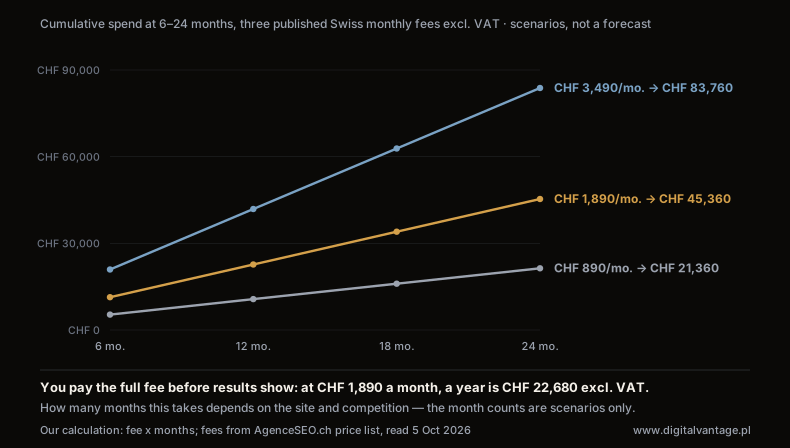
What you spend before SEO starts paying back
Our calculation: monthly fee multiplied by number of months, at the three plans of the AgenceSEO.ch price list (agenceseo.ch/tarifs, CHF excluding VAT, read 5 October 2026); months are scenarios, not a forecast
Chart description
Line chart of cumulative spend, in Swiss francs excluding VAT, at 6, 12, 18 and 24 months for the three monthly fees on one published Swiss SEO price list. 890 francs a month: 5,340 francs at 6 months, 10,680 at 12, 16,020 at 18, 21,360 at 24. 1,890 francs a month: 11,340 francs at 6 months, 22,680 at 12, 34,020 at 18, 45,360 at 24. 3,490 francs a month: 20,940 francs at 6 months, 41,880 at 12, 62,820 at 18, 83,760 at 24. The number of months is a set of scenarios to compare, not a forecast of how long results take.
At CHF 1,890 a month, the middle plan, a year costs CHF 22,680 and 18 months CHF 34,020, excluding VAT and before any audit. Budget as a fee times the number of months you are prepared to pay without a return, not as a monthly figure, and decide in advance what you will measure each month to see whether it is working: queries, sales, or traffic to specific pages (website KPIs covers how to choose). Count your own time too. Backlinko tells clients to "set aside a few hours each week for these collaboration tasks (at least at the beginning)": reviewing drafts, granting access, answering questions. No invoice lists that work, but you still pay for it.
Questions that make two SEO quotes comparable
Two offers become comparable only when both answer the same questions about money. The general warning signs in an SEO vendor, starting with a guaranteed first place, are covered in what decides whether Google shows your site. The price questions:
- How many hours a month, and whose? The split by seniority, and what happens to unused hours.
- Which language versions does the fee cover? One site in three languages is, for search, closer to three sites.
- What does the links line buy? How many placements, on which sites, and how the links are tagged.
- What happens to links and texts when the contract ends? Who owns the copy, whether the links are bought or rented, and whether they sit on sites the agency controls.
- Who writes the content, and who reviews it? Ask whether AI is used; on its own, Google doesn't penalise that.
- Which tools are included, and which are billed separately?
- If payment depends on rankings, how is position measured? Location, language, device, tool, frequency, and the fee for adding a keyword.
- What are the term, the notice period and the cost of leaving early? And is the price with or without VAT?
- Is "AEO" or "GEO" a separate line item? If so, ask Google's question: is the advice "aligned with Google Search's official guidance on optimizing for generative AI features?" (Do you need an SEO?).
- What access do they get on day one? For an audit, Google advises granting only "read access to Search Console (at this stage, don't grant them write access)"; Google Search Console shows how. The same page also puts it plainly: "Ultimately, you are responsible for the actions of any companies you hire".
An offer that answers these in numbers can be compared with another and checked again in six months. A price range gives you nothing to check.
FAQ
Frequently asked questions about SEO cost
We found no independent Swiss benchmark, only agency price lists and two global provider surveys in dollars. Of the two Swiss price lists we read that also state the work involved, one runs from CHF 890 to CHF 3,490 a month and the other starts at CHF 900, all excluding VAT. Two price lists are not a market. More useful than any range: ask how many hours the fee includes and divide, which gives you a rate you can compare.
Only on the surface. You pay once a keyword reaches, say, the top ten, but a ranking depends on the searcher's location, search history and settings, and, in Switzerland, on the language of the search too. The contract has to define where, in which language, on which device, with which tool and how often the position is checked; otherwise you are paying for a number nobody agreed on.
By Backlinko's description, $500 a month or less usually buys 5–10 hours, and Backlinko calls it best value for a small site with limited competition or a team that can carry out the recommendations. In a competitive niche, it is unlikely to cover content and links. Google says a small local business can probably do much of the work itself, and Search Console and PageSpeed Insights are free.
The standard Swiss VAT rate is 8.1%, and agencies usually quote excluding it, so check which basis each quote uses. If you buy from an agency abroad, your business may have to declare the VAT itself as acquisition tax; ask your accountant whether that applies to you.
The term, the notice period and the fee for ending early; how many hours the fee buys and which language versions it covers; what counts as a "link"; who owns the texts and whether the links survive the contract; and, if payment depends on rankings, exactly how position is measured. The governing law named in the agreement decides; for a dispute, talk to a lawyer.
Let's go through your SEO quote before you sign
Bring us the offer on your desk. We'll work out how many hours you're actually buying, what the links and content line items really cover, what a year of this costs, and what's missing from the contract. No promises about rankings.
Related Posts
- Online marketing — where to start and in what order
Five situations that bring companies to us for traffic and enquiries — from being invisible to holding a list of addresses nobody uses. Pick yours and read on.
- 1.Email marketing — where to start, and why open rates no longer tell you anything
Email marketing starts with one fact: open rates stopped measuring people in 2021. What Gmail has required since 2024, and what a lead magnet really yields.
- 2.QR Code and Short Link - how to use them in online marketing
A practical guide for entrepreneurs: how to use QR Code and Short Link, specific uses, creation instructions, analytics and pitfalls to avoid.
- 3.Renting your audience — what a social profile gives you, and what it never will
Meta announced the reach decline itself in 2018. Our own measurement shows how many people really arrive from social, and what remains when it goes down.
- 4.SEO — what actually decides whether Google shows your site
One page in five of our own site is indexed. What Google's documentation says about indexing, Core Web Vitals and ranking guarantees — and what to ask a supplier.
- 5.Conversion rate — what the number actually tells you, and what it does not
Our own 180-day funnel, including a step above 100%. What research says a good conversion rate is, and why other people’s case studies do not transfer.
- 1.
About the Team
Digital Vantage Team
Your Partner in Business, Digital Vantage Team
Digital Vantage team is a group of experienced professionals combining expertise in web development, software engineering, DevOps, UX/UI design and digital marketing. Together we carry out projects from concept to implementation - websites, e-commerce stores, dedicated applications and digital strategies. Our team combines years of experience from technology corporations with the flexibility and immediacy of working in a smaller, close-knit structure. We work in agile methodologies, focus on transparent communication and treat each project as if it were our own business. The strength of the team is the diversity of perspectives - from systems architecture and infrastructure, frontend and design, to SEO and content marketing strategy. As a result, the client receives a cohesive solution where technology, aesthetics and business goals go hand in hand.