E-invoicing and accountingFree tools and plansCosts and pricing13 min reading time15,461 characters2,536 words
Accounting software in Switzerland — CO 957, VAT and prices in CHF
Which books Swiss law requires (CO 957), effective vs net tax rate VAT, free tiers, and CHF prices for AbaNinja, Banana, Crésus, bexio and Klara.
Redakcja Digital VantageYour Partner in Business, Digital Vantage Team · Digital Vantage team is a group of experienced professionals combining expertise in web development, software engineering, DevOps, UX/UI design and digital marketing. Together we carry out projects from concept to implementation - websites, e-commerce stores, dedicated applications and digital strategies.
Our team combines years of experience from technology corporations with the flexibility and immediacy of working in a smaller, close-knit structure. We work in agile methodologies, focus on transparent communication and treat each project as if it were our own business.
The strength of the team is the diversity of perspectives - from systems architecture and infrastructure, frontend and design, to SEO and content marketing strategy. As a result, the client receives a cohesive solution where technology, aesthetics and business goals go hand in hand.
Published
Updated
Choosing accounting software for a Swiss small business takes four steps, and the price is only the last one. First the Code of Obligations decides which books you must keep. Then VAT decides whether you report at all, by which method and how often. Next you decide whether you keep the books yourself, with an accountant, or hand them over to a fiduciary. Only then do you compare software, always with the billing condition next to the price.
We read the Swiss federal law on Fedlex and the vendors' CHF price pages on 8 October 2026. Where the English Fedlex text exists we link it, but it has no legal force: the French, German and Italian versions are authoritative. For the Ordinance on the keeping and retention of accounting records (GeBüV, French "Olico") there is no official English text, so quotations are our translation. Cantonal matters, above all your income-tax return, are outside this article.
Which books you must keep: Code of Obligations Art. 957
Which books you keep depends on your legal form and your revenue: legal entities and businesses above CHF 500,000 revenue keep full books, smaller sole proprietorships and partnerships keep a simplified record. Art. 957 of the Code of Obligations (CO) draws the line:
- Full bookkeeping and financial reporting (Art. 957(1)) for all legal entities, so every AG (SA) and GmbH (Sàrl), and for sole proprietorships and partnerships with revenue above CHF 500,000 in the last financial year.
- Accounts on income and expenditure and on the asset position (Art. 957(2)) for sole proprietorships and partnerships with revenue below CHF 500,000 in the last financial year. We do not state how revenue of exactly CHF 500,000 is treated.
Art. 957(3) says the principles of proper bookkeeping apply by analogy to the simplified books. Those principles are in Art. 957a: complete, truthful and systematic recording, a voucher behind every entry, clarity, an approach suited to the size of the business, and traceability of the records. Art. 957a also lets you keep the books in the national currency or the main operating currency, in a national language or in English, and on paper or electronically. We found no Swiss rule that requires small businesses to keep their books in software. Electronic books are, however, governed by the GeBüV. Under Art. 6 the records must be available for inspection within a reasonable time until the end of the retention period and be made readable without aids on request. Art. 9 allows modifiable media only with integrity techniques (for example an electronic signature) and tamper-proof storage time (for example a time stamp), and Art. 10 requires regular integrity and readability checks, with a log of any data migration. Books and vouchers are kept for ten years (CO Art. 958f).
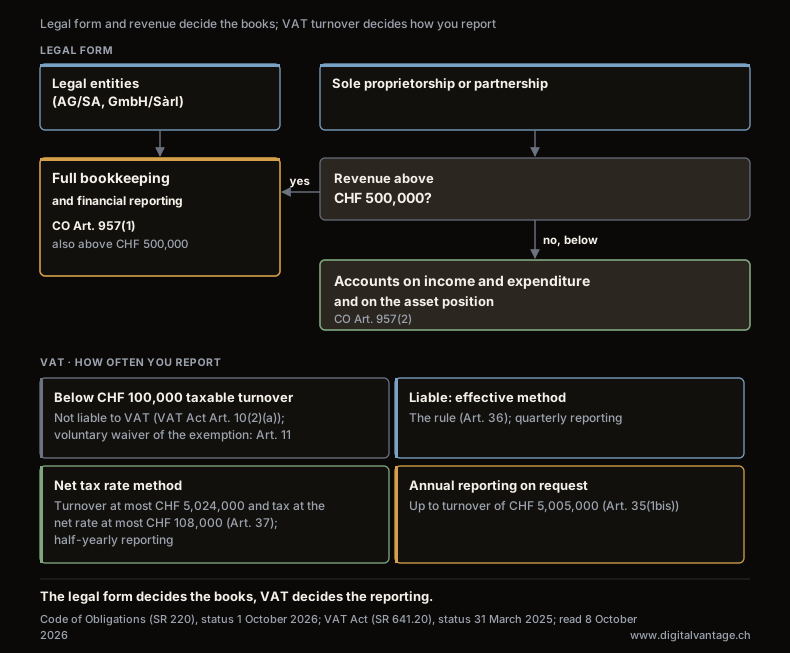
Legal form decides the books, VAT decides the reporting
Code of Obligations (SR 220), status 1 October 2026; VAT Act (SR 641.20), status 31 March 2025; read 8 October 2026
Chart description
Decision tree for Swiss small businesses. Legal entities (AG/SA, GmbH/Sàrl): full bookkeeping and financial reporting, CO Art. 957(1). Sole proprietorship or partnership with revenue above CHF 500,000: full bookkeeping, Art. 957(1). Sole proprietorship or partnership with revenue below CHF 500,000: accounts on income and expenditure and on the asset position, Art. 957(2). VAT strip: taxable turnover below CHF 100,000 means not liable (VAT Act Art. 10(2)(a), voluntary waiver Art. 11); liable: effective method as the rule (Art. 36, quarterly reporting) or net tax rate method if turnover is at most CHF 5,024,000 and tax at the net rate at most CHF 108,000 (Art. 37, half-yearly reporting); annual reporting on request up to turnover of CHF 5,005,000 (Art. 35(1bis)).
Swiss VAT: the method and the reporting period decide what the software must do
Below CHF 100,000 of taxable turnover you are not VAT-liable; above it, the method you use is the decision that matters for the software. The VAT Act (MWSTG, French LTVA), Art. 10(2)(a), exempts businesses with taxable turnover under CHF 100,000, and Art. 11 lets you waive the exemption for at least one tax period. If you are liable, there are two methods:
- Effective method. Art. 36(1): "in principle, the effective reporting method must be used". You deduct the input tax actually paid. Reporting is quarterly (Art. 35(1)).
- Net tax rate method. Art. 37(1) allows it if your annual taxable turnover is at most CHF 5,024,000 and the tax due at the net tax rate is at most CHF 108,000. You apply an approved rate to your taxable consideration; the rates reflect the usual input tax of the branch and are set by the Federal Tax Administration (FTA). You must apply for it, use it for at least one tax period, and after switching back to the effective method you cannot return to it for three years. Reporting is half-yearly. We quote no individual net tax rates, because we did not read them.
On request the FTA allows monthly reporting if you regularly have an input-tax surplus, and annual reporting if your taxable turnover is at most CHF 5,005,000 (since 1 January 2025; Art. 35(1bis) and Art. 35a). With annual reporting the FTA invoices provisional instalments (Art. 86a): with the effective method a quarter of the expected amount each, due within 150, 240 and 330 days from the start of the tax period; with the net tax rate method half, due within 240 days. The return and the payment are due within 60 days of the end of the reporting period (Art. 71(1) and Art. 86(1)). We do not state how a weekend or holiday shifts that deadline, because we did not read it.
The software consequence is plain. A VAT-registered business needs a product that supports its method (effective or net tax rate) and its reporting period and can produce the VAT report. A business below CHF 100,000 that keeps simplified books needs far less. Vendors say this themselves: AbaNinja lists "VAT method: Gross, net, balance" only from its Basic plan, and Banana's Advanced edition is described as "For those subject to Swiss VAT".
What the software handles during the year
The Swiss rhythm is simpler than a monthly calendar: VAT every quarter or half-year, AHV on account every quarter, and the annual accounts. AHV (OASI) contributions for the self-employed are paid on account each quarter, due by the 10th day after the quarter, and are settled against the final assessment. Amounts and the scale are in how much it costs to start a business. That payment is a bill from the compensation office, not an export from your software.
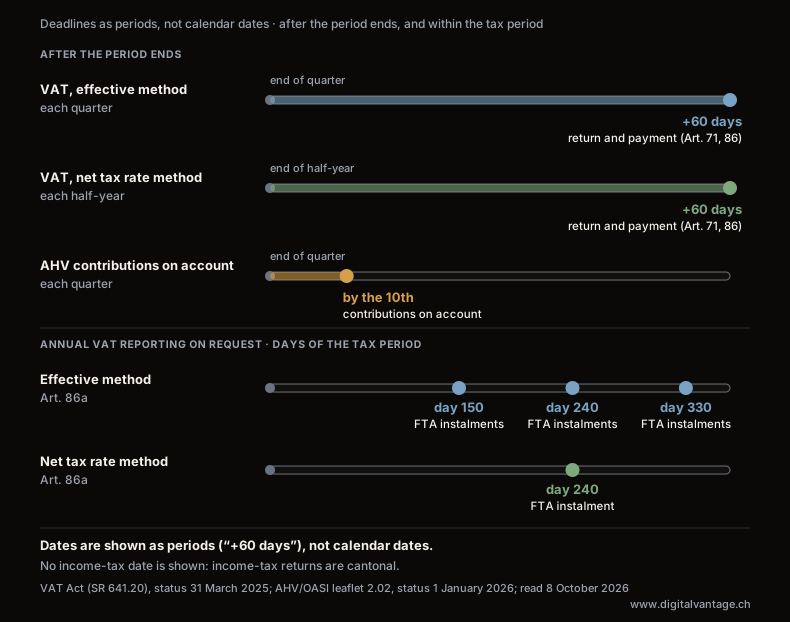
The Swiss rhythm of VAT and AHV
VAT Act (SR 641.20), status 31 March 2025; AHV/OASI leaflet 2.02, status 1 January 2026; read 8 October 2026
Chart description
Timeline. VAT with the effective method: return and payment within 60 days after the end of each quarter (VAT Act Art. 71 and 86). VAT with the net tax rate method: within 60 days after the end of each half-year. AHV contributions on account: by the 10th day after each quarter. Annual VAT reporting on request: FTA instalments on days 150, 240 and 330 of the tax period with the effective method, or on day 240 with the net tax rate method (Art. 86a). Dates are shown as periods ("+60 days"), not calendar dates; no income-tax date is shown because income-tax returns are cantonal.
A Swiss invoice has its own requirement: the QR-bill. Whether your software reads QR-bills and bank statements (camt.053 and camt.054) automatically is a better test than any feature list. Banana states "Import e-banking ISO 20022 (camt.053, 054)", bexio "AI posting of QR invoices and receipts", AbaNinja "QR invoices" and "70+ connected banks", and Run my Accounts "QR Zahlungseingang" (vendor statements). The invoice itself, the QR-bill and the e-invoicing question are in QR-bill and invoicing software in 2026; we state no Swiss duty of B2B e-invoicing here, because we found none confirmed either way.
Free accounting software in Switzerland
Two products have a free tier that fits a very small business, and neither includes everything.
- AbaNinja Starter, CHF 0. One user, 1,000 documents a year, QR invoices, balance sheet, income statement and general ledger. The VAT methods are missing: AbaNinja lists them from Basic (AbaNinja pricing, 8 October 2026). That suits a sole proprietor who is not VAT-liable.
- Banana Accounting Plus Free, CHF 0. All accounting apps up to 70 transactions (Banana, Switzerland (CHF), 8 October 2026). Enough to try the product or to keep a very small ledger.
Run my Accounts also lists a free "Startup" software tier, but it now sells its software to new customers only together with its services, so it belongs in the section on models below. We make no statement about free filing tools from the tax authorities, because we did not research them.
Accounting software prices in CHF
Self-service accounting software for a VAT-registered Swiss sole proprietor starts at about CHF 15 a month and goes up to CHF 48 and more, and the bases of the prices differ. Amounts are as displayed on the vendors' CHF pages on 8 October 2026. The bases are footnoted because they are not the same.
Vendor and plan | Price (CHF) | Billing | Tax basis | Vendor words |
|---|---|---|---|---|
AbaNinja Starter | 0 | none | none | 1 user, 1,000 documents a year, QR invoices; no VAT methods |
AbaNinja Basic | 21 per month | not stated | not stated | 3 users, 2,100 documents a year, VAT methods, permanent bank connections, eBill |
AbaNinja Pro | 49 per month | not stated | not stated | 5 users, 5,000 documents a year, inventory |
Banana Free | 0 | none | none | up to 70 transactions |
Banana Professional | 89 per year (about 7.42 a month, our arithmetic) | annual | not stated | income and expenses or double entry, invoices, fixed assets |
Banana Advanced | 179 per year (about 14.92 a month, our arithmetic) | annual | not stated | "For those subject to Swiss VAT"; "VAT Report valid from 2024"; email and phone support |
Crésus Comptabilité, rent | 20.00 per 30 days (21.60 incl. VAT) | 30-day rent | excl. VAT; incl. VAT also printed | desktop software; cancellable at 30 days |
Crésus Comptabilité, purchase | 600.00 once (648.60 incl. VAT) plus Crésus+ 120.00 per year | one-off plus annual | excl. VAT; incl. VAT also printed | updates via Crésus+ (90 days included on purchase) |
bexio Basic | 35.00 per month billed annually; 45.00 billed monthly | annual or monthly | excl. VAT | 1 user, quotes and invoices, accounting, e-banking, "Document archive (GeBüV compliant)" (vendor claim) |
bexio Advanced | 42.00 annual; 52.00 monthly | annual or monthly | excl. VAT | 2 users; payroll an extra CHF 7 a month for 1 employee |
Klara Business BASIC | from 48 per month | not confirmed | "All prices are exclusive of VAT" | AI accounting, CRM, orders, up to 3 admin users |
Klara Business PLUS / PREMIUM | 69 / 111 per month | not confirmed | exclusive of VAT | PREMIUM: eArchiv and free migration of an existing accounting system |
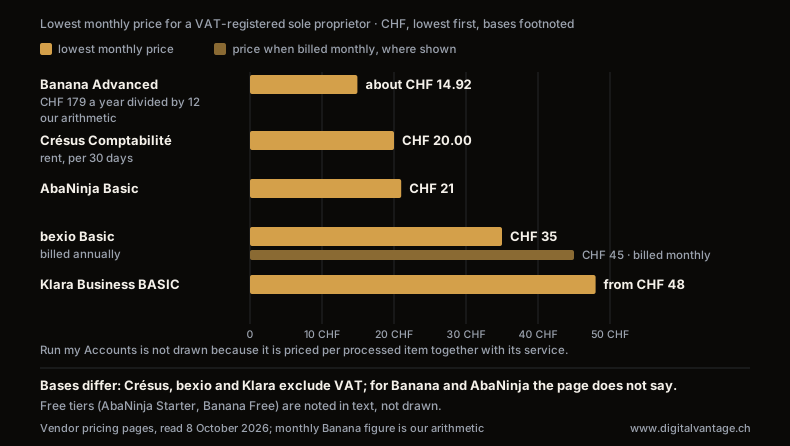
Accounting software for a Swiss sole proprietor: monthly price in CHF
Vendor pricing pages, read 8 October 2026; monthly Banana figure is our arithmetic
Chart description
Horizontal bars, lowest monthly price for a VAT-registered sole proprietor in CHF, lowest first, with the bases footnoted. Banana Advanced: about 14.92 (CHF 179 a year divided by 12, our arithmetic). Crésus Comptabilité rent: 20.00 per 30 days. AbaNinja Basic: 21. bexio Basic: 35 billed annually, second tint 45 billed monthly. Klara Business BASIC: from 48. Bases differ: Crésus, bexio and Klara exclude VAT; for Banana and AbaNinja the page does not say. Free tiers (AbaNinja Starter, Banana Free) are noted in text, not drawn. Run my Accounts is not drawn because it is priced per processed item together with its service.
The unit differs too. Crésus offers a real choice between renting and owning: renting at CHF 20.00 excluding VAT per 30 days, or buying for CHF 600.00 and then paying CHF 120.00 a year for updates. Banana and bexio are subscriptions; Banana states that "both the subscription and the payment are annual". Before you buy, read the contract terms: the billing period, the notice period (Crésus rent and Crésus+ are cancellable at 30 days) and the document limits that AbaNinja sets per plan.
Three ways to get the books done
"Accounting online" covers three services: software you use alone, software with a bookkeeper, and a fiduciary that works in its own system. The first model is the one above. In the second, a provider sells software and bookkeeping together. Run my Accounts prices its automated bookkeeping per processed item (voucher, extra line, payment, upload or bank posting), excluding VAT, billed monthly: package S has a base of CHF 0 plus CHF 1.80 per item, for businesses of roughly one to four employees; M CHF 35 plus CHF 1.40; L CHF 290 plus CHF 0.95 (Run my Accounts, German only). The provider states that new customers get the software only together with its services. Klara lists a setup service and a page for trustees, but we read no accountant price. In the third model the fiduciary uses its own tools and you hand over documents.
We did not research how Swiss fiduciary services are regulated or how liability is allocated, and make no claim about either. The duties of Art. 957 CO rest on the business that keeps the books, whoever does the work, and the contract defines what the fiduciary answers for.
Four questions usually decide:
- Are you VAT-registered, and by which method? It decides the plan: AbaNinja Starter or Basic, Banana Professional or Advanced.
- Do you have employees? Payroll is a separate module or service (Crésus Salaires, AbaNinja payroll runs, Klara Payroll at CHF 4.90 per payslip).
- How many vouchers do you handle a month? Bookkeeping packages are priced by volume.
- How much time do you want to spend? In the self-service model every error in an entry is yours.
How to choose accounting software: a checklist
Check Swiss accounting software against ten points before you buy.
- Simplified or full books: can it keep the ledger your Art. 957 case requires?
- VAT: your method (effective or net tax rate) and reporting period, and the VAT report.
- Annual accounts and retention: ten years of records and a GeBüV-compliant archive (a vendor claim at bexio; ask for it in writing).
- QR-bills and bank statements: automatic reading of QR-bills and camt.053 or camt.054 files.
- Bank connection: for your bank (AbaNinja states "70+ connected banks"; Run my Accounts "Täglicher Bank Sync").
- Payroll: if you have employees.
- Access for your accountant: ask whether it is included in the price.
- Export and exit: under GeBüV Art. 10 a data migration must be complete, accurate and logged; Klara PREMIUM offers free migration of an existing system.
- Security: two-factor login and a processor agreement. Under Art. 9 of the revised FADP you may assign processing to a processor by contract, you must satisfy yourself that it can guarantee data security, and no duty of confidentiality may prohibit the assignment. How to secure accounts is in protecting company data; what to ask a cloud provider is in cloud data security.
- Support and contract terms: bexio states "24/7 support (365 days a year)", Klara BASIC "24/7 chat and email support" and PLUS adds telephone support, Banana Advanced "Email and phone support", AbaNinja Starter "3 Support requests". Ask whether support covers accounting questions or only the software.
If you hold stock or manufacture, you may need more than accounting software; when a small business needs an ERP is in a separate article.
FAQ
Frequently asked questions about accounting software in Switzerland
Not necessarily. Below CHF 100,000 of taxable turnover a business is not VAT-liable, and a sole proprietorship under CHF 500,000 revenue keeps accounts on income and expenditure and on the asset position (CO Art. 957(2)). Art. 957a allows paper or electronic books. Software helps with vouchers, QR-bills and retention, and a free tier (AbaNinja Starter, Banana Free) may be enough to start.
In principle yes: CO Art. 957a allows paper, electronic or equivalent books. Electronic books must meet the GeBüV, which requires integrity techniques for modifiable media, regular readability checks and a logged data migration. Books and vouchers are kept for ten years (CO Art. 958f). Whether a spreadsheet meets the integrity requirements is something to settle with your fiduciary.
Yes, with limits. AbaNinja Starter is CHF 0 for one user and 1,000 documents a year but has no VAT methods; Banana Accounting Plus Free allows up to 70 transactions. We make no statement about free tools from the tax authorities.
Legal entities (AG/SA, GmbH/Sàrl) always keep full books. Sole proprietorships and partnerships do so from revenue above CHF 500,000 in the last financial year (CO Art. 957(1)); below that they keep a record of income, expenditure and the asset position.
On the vendors' CHF pages on 8 October 2026: AbaNinja Basic CHF 21 a month, Banana Advanced CHF 179 a year (about CHF 14.92 a month), Crésus rent CHF 20.00 excl. VAT per 30 days, bexio Basic CHF 35 a month billed annually or CHF 45 monthly, Klara Business BASIC from CHF 48. The tax bases differ, and an accountant or fiduciary is priced separately.
The effective method is the rule (VAT Act Art. 36). The net tax rate method is available at turnover up to CHF 5,024,000 and tax of up to CHF 108,000, with half-yearly reporting; you must apply to the FTA and cannot return to it for three years after switching away. Which suits you depends on your input tax, so ask your fiduciary.
Accounting, invoices, bank and shop in one flow?
We help connect accounting software to invoicing, your bank or an online shop, so documents and payments are not retyped by hand.
Related Posts
- Technology for a new business — what to buy in week zero, and what can wait
What to buy when starting a business in Switzerland: domain, mail, invoicing, CRM, office suite, brand — with sources.
- 1.Logo design for a business — copyright, trade marks, and the files you need
Logo design in Switzerland: the designer contract, whether a Canva or AI logo is yours, what a trade mark costs at the IPI, and the files you need.
- 2.Sole proprietorship in Switzerland: what AHV, VAT and the commercial register cost in 2026
Sole proprietorship Switzerland costs: AHV/IV/EO contribution rates for 2026, the VAT exemption and the commercial register, with two worked examples.
- 3.QR-bill and invoicing software in 2026 — what a Swiss invoice must contain
What a Swiss invoice must contain, the QR-bill timeline, and free versus paid invoicing tools, with a vendor-neutral data checklist.
- 4.Google Workspace pricing vs Microsoft 365 — plans and what you get in a small business
Google Workspace pricing from CHF 7 per user a month, Microsoft 365 Business Basic from CHF 5.67. Plans, storage, meetings and AI compared in Swiss francs.
- 5.Corporate design — what brand guidelines contain, and how to write them for a small business
Corporate design on two published examples: logo variants, minimum size, HEX/RGB/CMYK/Pantone colour, typefaces, and a checklist for a small business.
- 6.Business Model Canvas — what it is, and how to map yours on one page before you start a business in Switzerland
Business Model Canvas in nine fields, Lean Canvas, the Value Proposition Canvas, persona and competitor analysis — straight from the tools' own authors.
- 7.Business email — what a mailbox on your domain costs, and how to set it up
Business email on your own domain from under a franc to about CHF 8.40 a month. Where to host a mailbox, and the SPF, DKIM and DMARC records Gmail requires.
- 1.
About the Team
Digital Vantage Team
Your Partner in Business, Digital Vantage Team
Digital Vantage team is a group of experienced professionals combining expertise in web development, software engineering, DevOps, UX/UI design and digital marketing. Together we carry out projects from concept to implementation - websites, e-commerce stores, dedicated applications and digital strategies. Our team combines years of experience from technology corporations with the flexibility and immediacy of working in a smaller, close-knit structure. We work in agile methodologies, focus on transparent communication and treat each project as if it were our own business. The strength of the team is the diversity of perspectives - from systems architecture and infrastructure, frontend and design, to SEO and content marketing strategy. As a result, the client receives a cohesive solution where technology, aesthetics and business goals go hand in hand.